
Views: 0 Author: Site Editor Publish Time: 2026-09-01 Origin: Site


Planting trees, burying power poles, and digging tree pits - traditional manual digging is time-consuming and can also harm the waist? Four wheeled tractors paired with suspended excavators are becoming the "invisible strongmen" of modern agriculture and infrastructure construction! This article provides a detailed explanation of its working principle, core parameters, applicable scenarios, and purchasing techniques, helping you avoid the pitfalls of "buying the wrong thing and wasting money". From power matching to drill bit type, from operation depth to safety protection, this article explains how to choose the right equipment, so that every new tree can "easily enter the soil", increasing efficiency by more than double!
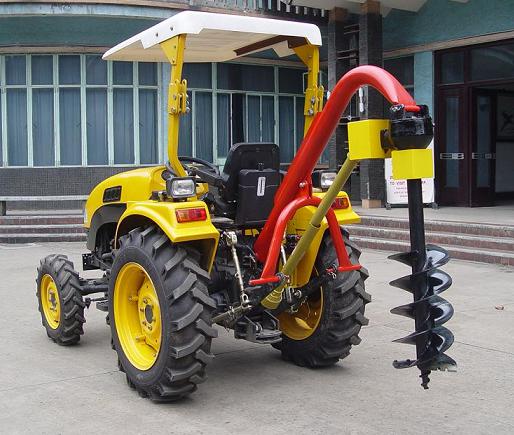
I. What is a four-wheel tractor with hole digger?
Simply put, it is to install a "pit digging specialized small machine" at the rear of a four-wheel tractor, drive the rotating drill bit through a hydraulic system, and quickly create circular deep pits on the ground - this is the efficient "hole digging artifact" in modern afforestation, power line laying, and landscaping projects!
It originated from the wave of farm mechanization in Europe and was later widely used in agricultural land renovation, ecological forest construction, and rural power grid upgrading projects in northern China. Nowadays, it is no longer just an "agricultural tool", but has become a standard tool for urban greening, highway slope treatment and other projects.
Imagine: in the past, a tree pit with a diameter of 60cm and a depth of 80cm was dug by shovel, and one person had to work for most of the day; And with this device, it can be done in 30 seconds without bending over! Is it a bit of a visual sense of 'technology changing life'?
II. How do you view the core principles and key parameters?
The core of an hole digger is "rotary cutting+downward pressure propulsion" - the drill bit rotates at high speed to cut through the soil, while applying downward pressure through a hydraulic cylinder to achieve rapid drilling. It's like stirring dough with a blender, but this time it's' stirring the soil '!
When making a purchase, pay attention to the following parameters:
(1)Drill bit diameter: commonly available in 30cm, 40cm, 50cm, 60cm, corresponding to different purposes. It is recommended to choose 40-50cm for planting ordinary trees, and 60cm or more for burying utility poles or large trees.
(2) Maximum excavation depth: generally between 60cm and 120cm, deep pits are suitable for trees with well-developed root systems or foundation pile driving.
(3) Power output requirement: The tractor usually requires a hydraulic output power of ≥ 30kW (approximately 40 horsepower), otherwise it cannot drive the drill bit to operate stably.
(4) Drill bit material: high-quality carbon steel or alloy steel, with strong wear resistance; Some high-end models use hard alloy blades, which have a longer lifespan.
(5) Homework speed: On average, one pit takes about 20-60 seconds, which is greatly affected by soil hardness.
III. Who is suitable for? Which scenes are most popular?
Suitable for:
(1) Forestry Bureau, Nursery Base, Ecological Restoration Project Team;
(2) Power companies, communication operators (buried utility poles, fiber optic cable wells);
(3) Municipal landscaping team, highway maintenance unit;
(4) Large scale growers and orchard management cooperatives.
Common usage scenarios:
(1) Large scale afforestation in spring, capable of completing over 300 tree pit operations in a day
(2) Rapid installation of pole foundations in rural power grid renovation
(3) Mountain terraced field maintenance, slope protection, grass planting and nest making
(4) Planting seedlings for green belts in parks and residential areas


