
Views: 0 Author: Site Editor Publish Time: 2026-11-23 Origin: Site


As the core power equipment of agricultural mechanization, tractors are mainly used to tow and drive various agricultural tools to complete field operations such as plowing, sowing, and harvesting. However, in actual agricultural production, tractors often need to undertake transportation tasks, such as transporting harvested grains, feed, livestock, or agricultural materials. This raises a question: why does a tractor need to be paired with a trailer?
I. Function Division
The core reason lies in the functional division of labor between the design positioning of tractors and transportation needs. Tractors usually do not have a large cargo space on their own, and their structural center of gravity, suspension system, and power output mode prioritize serving the traction and stability of field operations rather than carrying a large amount of cargo. Therefore, separating the transportation function and implementing it through trailers is a more reasonable technical route. This division of labor not only allows tractors to be used for multiple purposes, but also enables trailers to be specially designed according to different transport objects, thereby improving overall operational efficiency.
II. Mechanical Principles
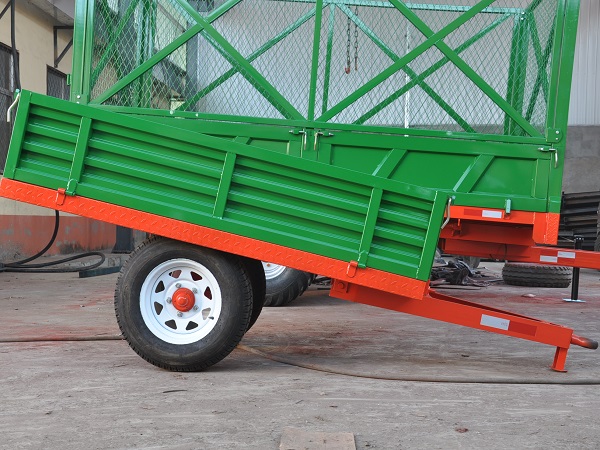
From the perspective of mechanical principles, the combination of tractor and trailer is a typical traction transportation system. The tractor is connected to the trailer through its rear traction device, converting the power generated by the engine into traction force to drive the trailer. The trailer itself has no power source and relies entirely on the tractor's traction. The advantage of this design is that after completing field operations, the tractor can be immediately transformed into a transport vehicle by simply attaching a trailer, without the need to purchase an additional dedicated transport vehicle. In agricultural scenarios, this flexibility is particularly important because agricultural production has obvious seasonality and task diversity. In addition, the carrying capacity and structural design of the trailer can be adjusted according to the characteristics of the transported goods. For example, when transporting grain, a sealed box may be required to prevent spills, while when transporting livestock, a ventilated and fenced structure is needed. Taking Yifa agricultural tractor high rail trailer as an example, it adopts a high rail grid design and a surrounding cage structure, precisely to meet the transportation needs of bulk materials such as livestock or corn cobs. Grid design can ensure ventilation while preventing small volume materials from falling, while high barriers can increase the loading capacity of a single transport and reduce the number of round trips.
III. Structural Design of Trailers
In industry perception, the structural design of trailers often directly reflects their expected usage scenarios and performance priorities. Dual axis design is a common structure in heavy-duty trailers, whose main function is to distribute the load and improve driving stability, especially on uneven farmland or rural roads. Although single axle trailers have a simple structure and flexible steering, their load-bearing capacity is limited and they are more suitable for lightweight transportation. A dual axle trailer increases the support points to distribute the weight of the cargo more evenly across multiple tires, reducing pressure on individual tires and suspension systems, while reducing the jolting and swinging of the trailer during driving. The wear resistance, waterproof, and anti-skid characteristics of tires are also specifically considered for agricultural environments, as farmland roads are often accompanied by mud, water accumulation, and gravel, and ordinary tires are prone to slipping or premature wear. The installation of safety taillights enhances visibility when driving on public roads, which is a safety factor that must be considered for agricultural vehicles on the road. These design details together constitute the practical value of trailers in agricultural transportation.
IIIV. Trailer Application
In practical applications, the combination of tractor and trailer is widely applicable in various agricultural scenarios. During the harvest season, a tractor attached to a high rail trailer can quickly transport grain or straw, avoiding losses caused by delayed transportation. At the farm, trailers with grid fences can safely transport livestock or poultry, ensuring ventilation and preventing animals from jumping out. For scenarios that require the transportation of agricultural inputs such as fertilizers and seeds, the rainproof and leak proof design of trailers is particularly important. The focus on trailers varies in different scenarios: if the main transportation is food, users will place more emphasis on the sealing and capacity of the cargo box; If transporting livestock, pay more attention to the height and ventilation of the fence; If driving frequently in mountainous areas or muddy roads, the dual axis design and tire anti-skid performance become key. Therefore, understanding the design logic and structural characteristics of trailers can help users make more appropriate judgments based on their own transportation needs, rather than blindly pursuing a certain indicator. This scenario based technological cognition is precisely the core ability that industrial knowledge popularization hopes to help readers establish.


