
Views: 4 Author: Site Editor Publish Time: 2026-06-29 Origin: Site


For small-scale farmers, rural property owners and independent landscaping contractors, equipment investment decisions always boil down to one core question: does the tractor backhoe deliver long-term value? Among the most popular auxiliary equipment in 2026, tractor backhoe attachments have sparked widespread debate. Many users wonder whether this affordable, versatile accessory can replace dedicated excavators and justify its purchase cost. Industry experts and long-term operators confirm that tractor backhoe attachments are a worthwhile investment for most private and small-business users, though their value depends heavily on equipment compatibility, job frequency, and usage scenarios.
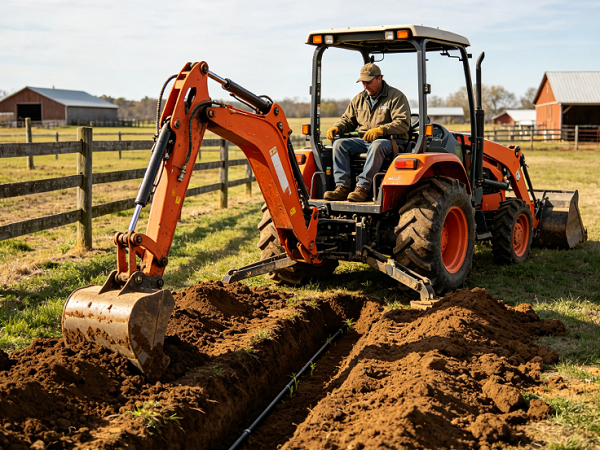
I. Superior Cost-Effectiveness With Low Operating Costs
The biggest advantage of tractor backhoe attachment lies in its outstanding cost-effectiveness compared to standalone excavation equipment. A brand-new compact dedicated backhoe loader usually costs $30,000 to $60,000 with additional annual expenses for engine maintenance, oil changes and parts replacement. In contrast, a high-quality universal backhoe attachment compatible with standard tractors only ranges from $3,000 to $8,000. It leverages the tractor's existing engine, hydraulic system, and three-point hitch, eliminating the need for maintaining a separate powertrain and chassis. Industry data shows that the attachment delivers roughly 80% of the excavation functionality of a professional backhoe at less than 20% of the total cost, making it a high-return tool for non-intensive construction work.
II. Multi-Functional Versatility for Diverse Scenarios
Versatility is another key factor driving its popularity among users. Traditional tractors are limited to mowing, plowing and light hauling, while backhoe attachment instantly transforms a standard tractor into a multi-functional construction machine. With simple mounting and no professional modification required, the attachment can handle daily tasks including trench digging for irrigation systems, fence post hole excavation, shed foundation digging, tree stump removal and small-scale land leveling. Farmers can mow fields in the morning and complete drainage trenching in the afternoon, drastically improving equipment utilization rate. For residential property owners managing acreage landscapes, it eliminates the hassle and high cost of renting excavators for sporadic small projects.
III. Field-Proven Reliability and Maneuverability
Practical user experience further validates the attachment's real-world reliability. Field tests on 25hp to 45hp compact tractors with standard three-point hitches and 10–12 GPM hydraulic flow show that mainstream backhoe attachments operate stably on farmland, uneven rural terrain and residential job sites. Most updated 2026 models feature heavy-duty steel frames, reinforced hydraulic cylinders and adjustable stabilizer legs, ensuring stable operation and a maximum digging depth of up to 9 feet, fully meeting the needs of daily farm maintenance and residential renovation. Unlike specialized excavators with bulky bodies, tractor-mounted backhoes offer superior maneuverability, easily accessing narrow farm paths, backyard spaces and enclosed job sites where large machinery cannot operate.
IIIV. Key Limitations to Consider Before Purchase
Nevertheless, industry insiders remind users that the attachment is not a one-size-fits-all solution, and it has obvious limitations. First, it is incompatible with low-power tractors. Tractors below 25 horsepower often lack sufficient hydraulic pressure and weight balance, leading to weak digging power and potential tilting risks during operation. Second, it cannot support large-scale, high-frequency engineering work. For commercial construction teams undertaking continuous deep excavation or heavy earth-moving projects, professional standalone backhoes remain irreplaceable due to their higher power, faster operating speed, and stronger load capacity. Additionally, users need to master basic operating skills and conduct regular hydraulic system inspections to avoid oil leakage or component wear caused by improper use.
V. Clear Return on Investment From Reduced Rental Costs
When evaluating return on investment, rental cost comparison serves as the most intuitive reference point. Local excavator rental fees typically range from $400 to $600 per day, excluding transportation and operator labor costs. For users who need excavation work only 8 to 10 times a year, the one-time purchase of a backhoe attachment can offset rental expenses within one to two years. Moreover, the functional upgrade effectively increases the tractor's resale value, bringing additional economic benefits for equipment replacement in the future.
In conclusion, the tractor backhoe attachment remains a highly valuable auxiliary tool in 2026 for targeted user groups. It is the ideal investment for family farms, rural landowners and small landscaping contractors with limited budgets and scattered small-scale excavation needs. For large engineering companies with high-intensity construction demands, professional dedicated equipment is still the better choice. As manufacturers continue to optimize hydraulic matching and structural design, modern backhoe attachments are becoming more stable, easier to install, and more user-friendly, further consolidating their status as a cost-effective must-have for tractor owners.


