
Views: 2 Author: Site Editor Publish Time: 2026-09-29 Origin: Site


I. Preparation before broadcasting
1. Machine adjustment and debugging
Before the start of the sowing season, a comprehensive inspection and maintenance should be carried out on agricultural machinery such as deep tillage machine, flipping plow, rotary tiller, spreader, ridge covering machine, and seeder according to the product manual to ensure that the machinery operates normally.
(1) Check whether the bolts and nuts between key parts such as the deep loosening shovel and the frame of the deep loosening soil preparation machine are loose, and check the wear of the deep loosening shovel. If the shovel tip is severely worn or deformed, it should be replaced in a timely manner.
(2) Check the wear of the plow body when flipping the plow, and replace it in a timely manner if it is severely worn. Test the working performance of the flipping mechanism to ensure that the flipping is flexible and reliable, and that the hydraulic cylinder has no leakage.
(3) Check the oil level of the transmission box gear of the rotary tiller. If it is lower than the oil level line, add the same type of gear oil. Replace the gap between the output spline shaft of the transmission box and the shaft sleeve of the blade shaft if it is severely worn. Check the oil seals at both ends of the blade shaft, as well as the blade shaft, blade seat, and blade. If it is damaged, replace it.
(4) Clean the residual fertilizer in the fertilizer box with the fertilizer spreader, check for any damage or leaks in the fertilizer box, and inspect the working status of the fertilizer discharge device to ensure even and smooth fertilizer discharge.
(5) Check whether the ridge components, shaping plates, etc. of the ridge laminating machine are deformed, inspect the working status of the laminating roller, laminating wheel, etc., ensure that the laminating is smooth, check the tension and wear of the transmission components such as chains and belts, and adjust or replace them.
(6) Check whether the tension of the transmission components such as chains and belts of the seeder is appropriate, adjust the tension in a timely manner, check the lubrication condition of each lubrication point, ensure that the lubrication of each rotating component is good, and check whether the seeder is flexible and whether there is any blockage or jamming.
2. Land selection and preparation
Choose plots with medium to high soil fertility, deep plow layers, and sufficient sunlight. It is advisable to use legumes, wheat, and melons for the previous crop to avoid repeated cropping. Before sowing, choose land preparation methods such as deep plowing, deep loosening, eradication treatment, rotary tillage, and raking according to the needs of the plot; Among them, the depth of deep tillage and deep loosening is ≥ 25cm, and the depth of rotary tillage is about 15cm. In areas where conditions permit, multifunctional joint work tools should be used for operations. After land preparation, the soil becomes loose and the flat soil has sufficient moisture content, creating favorable conditions for ridge formation and mulching. Dryland agricultural areas should carry out top covering and film covering as early as possible during soil thawing, and press the soil after laying the film.
3. Apply sufficient base fertilizer
Adjust the amount of fertilizer according to soil fertility and potato varieties. In areas where conditions permit, soil testing and formula fertilization technology can be promoted to promote precise, green, and specialized fertilization, improve fertilizer utilization efficiency. Potato fertilization is mainly based on base fertilizer. Before sowing, combined with deep plowing and land preparation, organic fertilizer and chemical fertilizer are applied in combination, and equipment such as spreaders are used to reduce auxiliary labor.
II. Variety selection
Select suitable planting modes according to local agricultural requirements, guided by the demand for high-quality industrial development, combined with the characteristics and suitable regions of each variety, choose high-yield, stable yield, suitable for mechanical operation, and excellent resistance varieties.
III. Potato processing
After the seed potatoes are taken out of the cellar (storage), strict selection is carried out to remove diseased, insect bitten, and rotten potatoes. The ones with neat shape and obvious variety characteristics are selected as seed potatoes, and the seeds are sun dried 1-2 days before sowing. Before cutting the seeds, cut the navel for inspection, eliminate diseased potatoes, eliminate tail buds, and cut them into blocks of 25-50 grams in size, each with 1-2 bud holes. Prepare two knives and a pot of potassium permanganate disinfectant with a concentration of 0.10% when cutting potatoes into pieces. After cutting one seed potato, switch to the second knife and immerse the first knife in disinfectant. When cutting diseased potatoes such as ring rot and black shank, eliminate the diseased potatoes and immediately change the knife to prevent the spread of the disease. Concentrate the cut potato chunks and mix them with fungicides and bactericides according to the prescribed dosage and method to ensure even adhesion of the agents on the surface of the potato chunks and achieve good disease prevention effects. Agricultural machinery cooperatives engaged in large-scale planting recommend using mature potato seed potato cutting machines to save labor costs and improve cutting efficiency.
IIIV. Selection of sowing equipment
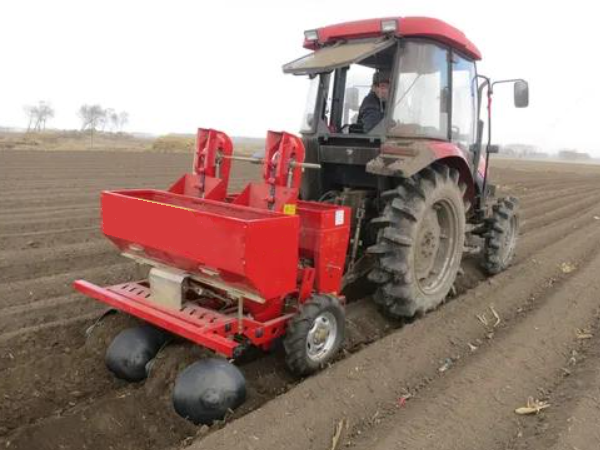
Reasonably select ridge mulching and potato digger according to the potato planting mode, and give priority to selecting equipment that has entered the national subsidy catalog for operation. It is recommended to use compound operation equipment such as one-time fertilization, ridge formation, mulching, sowing, and soil covering. Depending on the needs of irrigation and fertilization, drip irrigation pipes (belts) and pesticide application devices can be optionally installed. Choose potato film seeders for autumn and top edge mulching plots. High ridge potato planting areas in the central and eastern regions, as well as the mountainous areas of Longnan, can choose segmented operation equipment such as ridge raising, mulching, and sowing to achieve maximum "machine replacement". Before the formal sowing operation, the sowing machine should be properly debugged according to the requirements, and trial sowing should be carried out to confirm that the debugging is in place. The sowing amount, fertilization amount, sowing depth, fertilizer depth, plant (hole) spacing, row spacing, etc. should meet the agronomic requirements.
V. Quality requirements for sowing
It is recommended to use tractors equipped with Beidou navigation assisted driving system for seeding operations (ridge and film laying operations) to improve the accuracy and uniformity of row spacing (ridge spacing), and enhance the quality of seeding. Quality requirements for sowing operations: hole rate ≤ 5%, qualified rate of soil cover depth ≥ 80%, qualified index of seed potato spacing ≥ 80%, qualified rate of adjacent row spacing ≥ 90%.


