
Views: 9 Author: Site Editor Publish Time: 2026-06-30 Origin: Site


As small-scale farming, residential landscaping and rural construction projects boom across North America and Europe, tractor owners are increasingly upgrading their equipment with aftermarket backhoe attachments to replace costly rented excavators. A widespread question sweeping the agricultural machinery industry remains unresolved for many users: Can you put a backhoe on any tractor? Industry experts and equipment manufacturers recently released systematic guidelines, confirming that universal compatibility is a myth, while outlining clear technical standards, safety thresholds and exceptions for backhoe installation.
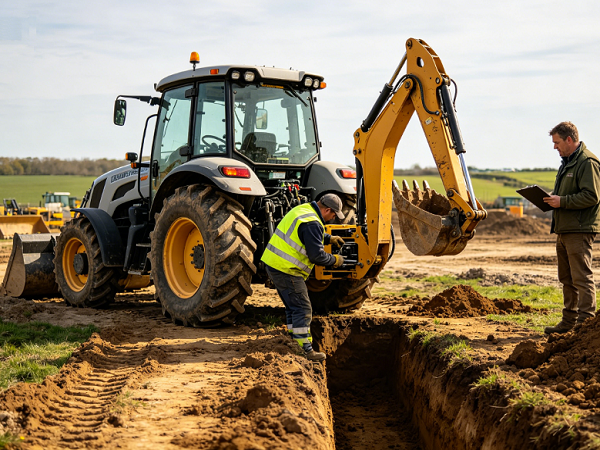
I. Booming Demand Drives Widespread Compatibility Misconceptions
For decades, aftermarket backhoe attachments have been hailed as a cost-effective solution for tractor owners. Instead of purchasing a dedicated backhoe loader that costs tens of thousands of dollars, users can install a rear-mounted digging attachment on existing tractors to handle trenching, post-hole digging, drainage construction and small-scale earthmoving tasks. Market data shows that tractor backhoe attachment sales have surged 28% year-over-year in 2026, driven by rising equipment rental fees and the growing popularity of compact farm machinery. However, the misconception that "all tractors fit all backhoes" has led to frequent installation failures, operational safety hazards and equipment damage cases in recent years.
II. Three Core Technical Criteria for Backhoe Compatibility
(1) Minimum Engine Horsepower Requirement
The core factor determining backhoe compatibility lies in three key tractor configurations, according to technical specifications released by leading machinery manufacturers including John Deere and Kelley Manufacturing. First and foremost is engine horsepower. Professional testing verifies that tractors require a minimum of 25hp to support basic backhoe operation. Low-horsepower garden tractors and mini compact tractors below this threshold lack sufficient power to drive hydraulic systems, resulting in weak digging force, system stalling, or even burnout of hydraulic components during operation.
(2) Standard Three-Point Hitch Mounting System
The three-point hitch system serves as the foundational mounting structure for backhoes. Most mainstream aftermarket backhoes are designed for Category 1 or Category 2 standard three-point hitches, which are widely equipped on modern farm tractors. Older or ultra-light-duty tractors with non-standard hitch structures cannot achieve stable and safe installation, even with customized adapters. Professional maintenance technicians emphasize that mismatched hitches will cause the backhoe to shake violently during operation, triggering structural deformation or falling risks.
(3) Matching Hydraulic System Performance
Hydraulic system matching is indispensable for stable backhoe performance. Traditional integrated backhoes rely on the tractor's built-in hydraulic circuit to provide power and flow. Tractors with insufficient hydraulic flow or outdated hydraulic valve structures cannot support the continuous expansion and contraction of backhoe booms, dipper arms and buckets. Fortunately, technological upgrades have optimized this limitation. New-generation independent hydraulic backhoe attachments, powered by tractor PTO shafts, come with self-contained hydraulic pump systems, enabling installation on tractors without dedicated hydraulic interfaces and greatly expanding compatibility.
III. Weight Balance and Operational Safety Constraints
Beyond technical parameters, weight balance and safety standards are critical non-negotiable factors. A fully assembled backhoe typically weighs 200 to 500 kilograms. Lightweight tractors with low curb weight will suffer severe rear-end overload after installation, leading to unbalanced body gravity, reduced driving stability and even rollover accidents during high-intensity digging operations. Industry safety regulations explicitly prohibit installing heavy-duty backhoes on ultra-compact tractors without counterweight modifications.
IIIV. Practical Application Boundaries and Exception Cases
There are also clear boundary cases in practical application. Machinery retailers and senior farmers have verified that most mainstream tractors produced in the past 40 years, including classic models such as Ford 3910 and Massey Ferguson 135, can be matched with suitable backhoe accessories through adjustable adapters without complex welding or customized refitting. In contrast, specialized lawn tractors, single-purpose garden tractors, and modified agricultural machinery with altered original structures are completely unsuitable for backhoe installation.
V. Industry Guidelines and Future Technological Trends
To help users avoid blind purchases and risky modifications, industry associations have updated the 2026 Tractor Attachment Compatibility Guide. The guide recommends that users prioritize confirming tractor horsepower, hitch category and hydraulic conditions before purchasing backhoes, and select lightweight independent hydraulic backhoes for small-horsepower tractors to ensure operational safety. Meanwhile, manufacturers are accelerating the development of modular, universal backhoe kits, aiming to further reduce installation thresholds while strictly complying with safety load standards.
In conclusion, while backhoe attachments boast high adaptability, not every tractor can safely and effectively mount a backhoe. Standard farm tractors with over than 25hp, standard three-point hitches and qualified bearing capacity are fully compatible with mainstream backhoes, while ultra-light, non-standard, and professional garden tractors are excluded. As agricultural machinery technology continues to iterate, the industry will form more unified universal standards, allowing tractor owners to maximize equipment utilization while eliminating potential safety risks.


