
Views: 12 Author: Site Editor Publish Time: 2026-07-01 Origin: Site


In modern agriculture, construction and land maintenance, compact tractors have become indispensable multi-functional workhorses, largely thanks to their compatibility with diverse attachments. Among all auxiliary equipment, the backhoe is one of the most widely used tools, empowering ordinary tractors to complete excavation, ditching, foundation digging and land renovation tasks. A core question for equipment operators and industry practitioners remains: how does a backhoe securely and efficiently attach to a tractor? Professional mechanical manufacturers and agricultural equipment experts have standardized the mounting process, combining mature hitch systems and hydraulic connection technology to ensure stability, safety and operational efficiency. This article breaks down the professional attachment mechanism, step-by-step procedures, and technical advantages of tractor-backhoe integration.
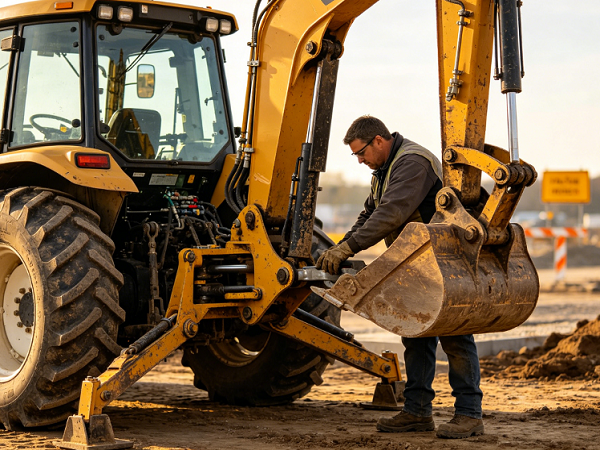
I. Core Structure: Standard Three-Point Hitch System
The foundation of backhoe-tractor attachment lies in the standard three-point hitch system, the universal connecting architecture for modern agricultural and engineering tractors. Classified by load-bearing capacity, Category I and Category II hitches are the most common configurations for compact and utility tractors, perfectly matching mainstream small and medium-sized backhoes. Unlike rigid welded connections, the three-point hitch design consists of two lower draft arms and one top link, forming a stable triangular stress structure. This structure disperses the huge vibration and torsion generated during backhoe excavation, preventing equipment deformation and loose connection. Most tractor manufacturers reserve fixed mounting plates and pin holes at the rear of the fuselage, while supporting backhoes are equipped with matched frame joints, realizing precise docking without custom welding or mechanical modification.
II. Technological Upgrade: Quick-Attach Mounting System
In recent years, the industry has widely promoted the quick-attach mounting system, a technological upgrade that greatly simplifies traditional installation steps. Leading equipment brands such as John Deere and Legacy Equipment have optimized the rear mounting structure, adopting a 4-point quick-attach design. The pre-installed RSA (Rear Stabilizer Assembly) mounting plates on the tractor can be permanently fixed without frequent disassembly, allowing operators to complete backhoe docking directly from the tractor seat. This innovative design eliminates the need for manual alignment of heavy equipment, cutting installation time by more than half and significantly reducing manual labor intensity.
III. Standard Pre-Docking Operational Steps
The complete backhoe attachment process follows standardized operational procedures with strict safety specifications. First, the operator drives the tractor backward slowly, aligning the rear fuselage with the backhoe frame, stopping when the two devices are approximately 20 centimeters apart. The tractor is then parked stably with the parking brake engaged and the engine idled to eliminate mechanical vibration during docking. Next, the tractor's rockshaft arms are lifted via the hydraulic control lever, enabling the pins at the end of the draft arms to accurately engage the reserved hooks and slots on the backhoe's main frame. Operators need to confirm that the bottom notches of the backhoe frame are fully seated on the tractor's bottom mounting hooks, and the top reserved holes are completely aligned for subsequent fixing.
IIIV. Mechanical Locking and Hydraulic Connection
After mechanical frame docking, fixed locking is the key to ensuring operational safety. Workers insert high-strength L-pins and lynchpins into the aligned mounting holes to lock the backhoe frame and tractor hitch firmly. For misaligned individual parts, the movable latch plates on the mounting frame can be fine-tuned to ensure a tight and gap-free connection. Following mechanical locking, the hydraulic system connection is initiated, the core step that enables backhoe functional operation. Operators route the hydraulic hoses through the standard hose guide, connecting the matched interfaces of the tractor's hydraulic output system and the backhoe's boom, bucket and stabilizer hydraulic circuits. It is critical to relieve residual pressure in the tractor's hydraulic circuit before connection to avoid hose damage or hydraulic oil leakage caused by pressure impact.
V. Final Inspection and Functional Debugging
The final debugging and inspection procedures determine the overall connection quality. Operators restart the tractor and test the hydraulic control lever to lift, lower, and swing the backhoe boom, verifying flexible and unobstructed hydraulic transmission. Meanwhile, the backhoe's rear stabilizers are lowered to test the overall stability of the connected equipment, ensuring no shaking or loose joints during load-bearing. Professional technicians emphasize that standardized connection not only improves work efficiency but also extends equipment service life. Improper installation, such as incomplete pin locking or unconnected hydraulic hoses, will lead to equipment swing during excavation, even causing mechanical failure and safety accidents.
VI. Practical Value and Industry Application Prospects
Industry data shows that tractors equipped with standard mounted backhoes can expand their working scenarios by more than 70%, covering farmland ditching, rural road maintenance, small construction excavation and garden renovation. The modular attachment design realizes the multi-functional value of a single tractor, reducing equipment purchase costs for individual farmers and engineering teams. With the continuous upgrading of agricultural machinery technology, the quick-attach and intelligent docking systems are becoming more popular, further lowering the operational threshold and improving the safety and intelligence level of mechanical matching.
In conclusion, the attachment of a backhoe to a tractor is a systematic engineering process integrating mechanical positioning, locking fixation, and hydraulic matching. Relying on the mature three-point hitch system and optimized quick-attach technology, the whole process is standardized, efficient, and safe. Strictly following professional installation procedures is not only the premise of giving full play to backhoe performance but also the core guarantee of safe and stable operation of tractor equipment. As agricultural and engineering mechanization continues to advance, this classic mechanical matching technology will continue to empower grassroots production and construction work.


