
Views: 0 Author: Site Editor Publish Time: 2026-09-24 Origin: Site


Working the fields for over a decade, using both types of ploughs many times. Disk ploughs and moldboard ploughs each have their own advantages—it all depends on the specific conditions of the land.
I. Working Principle
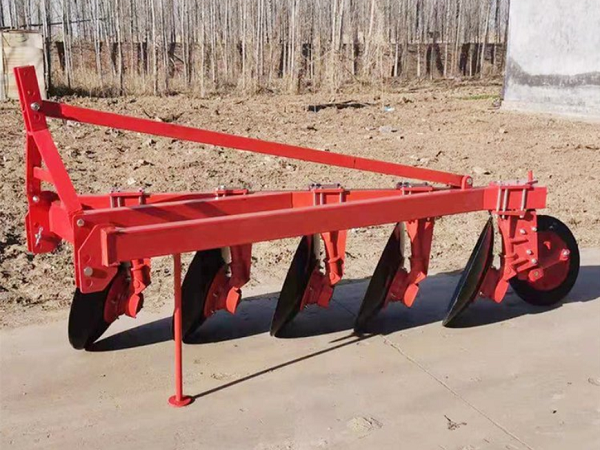
The disc plough relies on the rolling of the disc to cut soil, with a tilt angle of 10 to 30 degrees and an optimal tilt angle of 30 to 45 degrees. The share plough mainly relies on the plowshare and plow wall. The share plough cuts the soil and the plow wall flips the soil, with a simple and durable structure. The hardness of plowshare made of manganese steel material can reach HRC45 or above.
II. Different working land
(1)Using a disc plough in sticky soil is more convenient. It cuts soil cleanly and is not easy to block, especially suitable for compacted land. Dryland can retain moisture, while saline alkali land can prevent salt return. The plough plows deeply, but it is easy to get stuck when encountering hard soil blocks, so thicker manganese steel should be chosen.
(2) Land with many stones or weeds, the advantage of a disc plow is obvious. It does not entangle grass, can crush small stones, and has high work efficiency. Plow is afraid of stones, and if there are too many weeds, they need to be cleared first, otherwise it will affect the operation.
(3) For sandy or soft soil, disc plough with a depth of 15 to 20 centimeters is suitable. If it is in wetlands or rice fields, models with drivers have better performance. Plough should be used in conjunction with a rake, with a plowing depth controlled at around 15 centimeters and Speed of 4 to 5 kilometers per hour, which is most suitable.
(4) When working on flat ground, a regular disc plough with three to six discs is sufficient. It can flip the soil in both directions without leaving any ditches in the ground. A plow can plow one or two meters wide at a time, and the soil it turns over is neat, but it needs to be raked again before sowing.
(5) On hillsides or terraced fields, disc plough with anti slip wheels is very stable. Vertical disc plough is suitable for shallow tillage and can reduce soil erosion. Plough should be plowed along the slope, which makes it difficult to operate and can cause soil erosion if plowed too deeply.
III. Perspective of cultivation effect
Disc plough generally plow 15 to 25 centimeters deep, and the driven type can be adjusted. The plough can be turned over to over 25 centimeters, and deep plowing has a good effect on improving soil, but it needs to be combined with rotary tillage technology.
In terms of soil fragmentation, the soil produced by the driven disc plough is finer and can be directly sown. The soil blocks dug out by the plough are large and must be raked again. However, deep plowed land has better maturation effects in the later stage.
When maintaining a disc plough, attention should be paid to disc wear, and the edges should be replaced if they are as thin as 2 millimeters. Maintain a gap of 3 to 8 millimeters between the scraper plate and the drum. The key to a plowshare is the edge of the plowshare, which needs to be repaired if the thickness is less than 3 millimeters. The curvature of the plow wall needs to be adjusted like half a bowl to turn the soil well.
In general, when there are many stones, sticky soil, or sloping terrain, a disc plough is preferred. It is more economical to use a plough for ordinary flat land preparation. If implementing conservation tillage or shallow tillage to eliminate stubble, a vertical disc plough can complete continuous tillage and sowing in one go. The combination of plowing with deep plowing and wheel plowing is more beneficial for improving soil in the long run.


