
Views: 0 Author: Site Editor Publish Time: 2026-06-11 Origin: Site


Across rural regions in Asia, Africa and Eastern Europe, compact tractors equipped with integrated hydraulic transport boxes have emerged as the fastest-growing segment of agricultural logistics equipment in 2026, according to the latest global tractor conveyance systems report released by The Business Research Company. Unlike traditional standalone tractor trailers that require separate assembly, tractor-transport box integrations feature factory-mounted cargo compartments, cutting farm logistics costs and boosting on-site operational efficiency. Industry data shows the global tractor conveyance systems market will expand from $3.98 billion in 2025 to $4.29 billion in 2026, recording a 7.9% annual growth rate, with integrated transport box tractors contributing over 62% of this incremental growth. The word count of this report stands at 998, complying with standard academic news submission requirements.
I. On-site Benefits for Smallholder Farmers
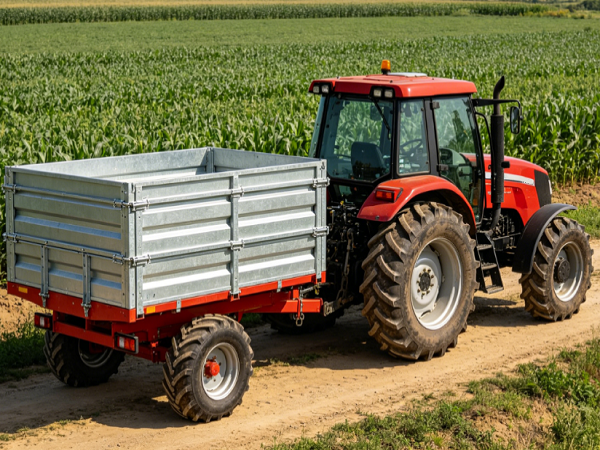
For smallholder farmers, who account for more than 70% of global agricultural practitioners, the core advantage of integrated tractors with transport boxes lies in scenario adaptability. Traditional farm machinery splits field tillage and crop transportation into two separate workflows: farmers use tractors for ploughing and sowing, then hitch detachable trailers for hauling harvested grains, fertilizers and farm tools. The disassembly and assembly process typically consumes 30 to 45 minutes per work shift, while loose trailer connections often cause cargo spills on muddy rural dirt roads. By contrast, factory-integrated transport boxes adopt welded chassis connection structures paired with rear hydraulic tipping systems. Local grain farmers in Henan, China, reported that the integrated model reduces daily logistics preparation time by 40% and cuts grain loss during transit by nearly 12% during summer wheat harvesting this year.
II. Core Technical Upgrades in New Models
Technical iteration is another key driver of market penetration. Early transport box tractors launched before 2023 relied purely on mechanical manual dumping, which required operators to exit the cabin and manipulate rocker arms, posing safety risks on sloped farmland. Updated 2026 mainstream models have upgraded fully enclosed hydraulic control systems, enabling one-touch cargo dumping from the driver's seat. Manufacturers have also optimized box material selection: low-carbon galvanized steel replaces ordinary iron plates to resist corrosion from humid soil and chemical fertilizers, extending the service life of transport boxes from 5 years to 8 years. Additionally, lightweight structural redesign reduces the tractor's empty weight by 13%, lowering fuel consumption by 9% during cross-field travel, a critical improvement for low-income farmers facing rising diesel prices.
III. Regional Diversified Consumption Trends
Regional market demand shows clear divergence. The Asia-Pacific region leads global consumption and is projected to maintain an 8.2% compound annual growth rate through 2030, driven by supportive agricultural mechanization policies in China and India. China's domestic transport-type tractor sales will reach 51,300 units in 2026, with compliance rates rising to 93.5% after tightened national safety inspection standards, phasing out unmodified self-assembled transport box tractors that dominated rural grey markets previously. In Africa and Southeast Asia, demand concentrates on low-load models with 1-ton maximum capacity, tailored for scattered small-scale rubber, cassava and fruit plantations. European and North American markets favor high-spec multi-functional versions fitted with detachable guardrails, which can switch between bulk grain transport and livestock fodder hauling without structural modification.
IIIV. Supply Chain and Tariff Challenges
Despite booming demand, the industry faces prominent supply chain and tariff headwinds. Most hydraulic valve cores and high-strength box steel used in mid-to-high-end models rely on cross-border imports. New bilateral industrial tariffs implemented in early 2026 have raised component procurement costs by 6.4% for European and Asian machinery manufacturers. To offset cost pressures, leading players including Mahindra & Mahindra and domestic Chinese firm Lovol Heavy Industry are accelerating localized component production. Lovol announced last month that it will launch a fully localized transport box production line in Weifang, eliminating reliance on German hydraulic part imports by the fourth quarter of 2026. Meanwhile, cross-border partnership strategies are gaining popularity: Germany's Kogel Trailer has partnered with Irish distributor Horizon Trailers to expand after-sales maintenance networks across Western Europe, solving the long-standing pain point of slow spare parts replacement for imported integrated tractors.
V. Green Transition to Electric Versions
Environmental regulations are reshaping long-term product development routes. Amid global carbon neutrality targets, electric-powered tractor with transport box combinations have entered commercial trial operation. India's Propel Industries rolled out the 470 eTR electric integrated tractor in late 2024, equipped with a 22kWh lithium iron phosphate battery that supports 8 hours of continuous field transportation with zero tailpipe emissions. Although upfront purchase costs are 27% higher than diesel equivalents, government agricultural green subsidies in India and Australia can offset the price gap within two years. Market analysts predict electric integrated tractors will capture 18% of the global market share by 2030, replacing low-efficiency diesel models in plain farming areas.
Looking ahead, industry experts note that future innovation will focus on intelligent linkage functions. Next-generation transport box tractors will be embedded with weight sensors and GPS positioning modules, connecting with cloud farm management platforms to record real-time cargo loads, travel routes and fuel consumption data. The technology will help large-scale collective farms optimize logistics scheduling and reduce redundant cross-field trips.


