
Views: 0 Author: Site Editor Publish Time: 2026-06-09 Origin: Site


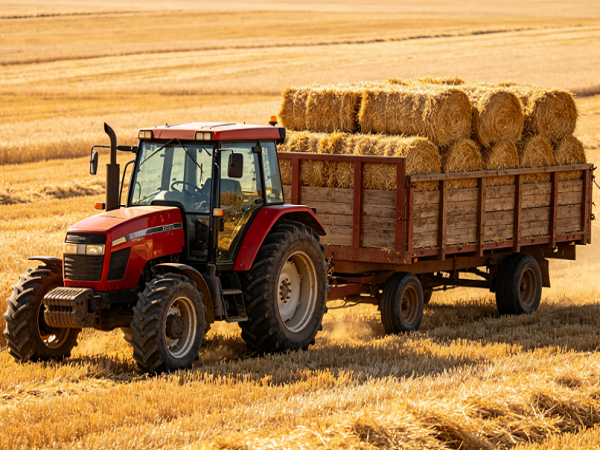
As global agriculture continues to advance toward mechanization, efficiency and intelligence, the combination of tractors and farm trailers has become an indispensable core equipment system for modern agricultural production. Far beyond basic field transportation, tractor-trailer units have evolved into diversified functional tools with multiple categories, adapting to complex farming links, diverse crop types and variable farmland environments. With flexible structural designs and powerful load-carrying capacity, these combinations effectively reduce labor costs, shorten operation cycles, lay a solid foundation for large-scale and standardized agricultural production worldwide.
I. Mainstream Classifications of Modern Farm Trailers
Farm trailers, as key supporting equipment for tractors, have formed a complete classification system based on structural design, functional attributes, and operational purposes, each tailored to specific agricultural scenarios. The most widely used type is the hydraulic dump trailer, a staple for ordinary farms. Equipped with a high-strength open box and an automatic hydraulic lifting system, this trailer can unload granular crops, soil, fertilizer, and gravel quickly by lifting the carriage and opening the rear tailgate without manual labor. Innovative upgrades such as three-way tipping and high-lift dumping designs further enhance its flexibility, allowing unloading on the left, right, and rear sides, and adapting to high-position stacking of grains and materials. It is the most cost-effective choice for daily farm material transportation and field land consolidation.
Flatbed farm trailers represent another mainstream category, renowned for their ultra-high versatility. Featuring a flat, barrier-free deck and adjustable guardrails, they excel at transporting large, irregular and heavy agricultural equipment, including combine harvesters, rotary tillers and irrigation facilities. Different from dump trailers focused on bulk materials, flatbed trailers prioritize load stability and cargo compatibility, with reinforced frame structures and anti-slip designs to ensure oversized machinery remains fixed during cross-field and rural road transportation. Low-bed flatbed trailers, a specialized branch, adopt an ultra-low deck design to lower the overall gravity, effectively solving the transportation challenges of super-tall and super-heavy agricultural machinery on rugged farm roads.
II. Specialized Trailers for Segmented Agricultural Needs
In addition to general-purpose models, professional specialized farm trailers meet segmented agricultural production needs. Livestock transport trailers are equipped with breathable fence structures and anti-collision protection devices, providing safe and comfortable transportation spaces for cattle, sheep, pigs, and other livestock, reducing animal injury and stress during transit and improving the efficiency of livestock farm product circulation. Sealed cargo trailers with fully enclosed carriages shield grains, seeds, and precision agricultural tools from rain, dust, and sunlight damage, making them ideal for transporting high-value and moisture-sensitive agricultural supplies. Moreover, professional functional trailers such as liquid fertilizer tank trailers and forage transport trailers have emerged, realizing integrated transportation and fertilization or collection and storage, further enriching the operational functions of tractor-trailer units.
III. Full-scenario Applications in Agricultural Production
The diverse types of tractor with trailer units correspond to rich and refined application scenarios throughout the entire agricultural production chain. In the planting and growing stage, they undertake the transportation of seeds, organic fertilizers, pesticides, and irrigation tools, realizing rapid material distribution from farm warehouses to scattered field plots and ensuring timely progress of sowing and fertilization operations. For large-scale farmland renovation, dump trailers efficiently transport earthwork and backfill materials, supporting land leveling, ditch digging and field road maintenance, greatly improving the efficiency of farmland infrastructure construction.
The post-harvest stage is the core application scenario of tractor with trailer. After crop ripening, the units quickly transport harvested wheat, corn, rice, and cash crops from field operation areas to drying yards, warehouses, or purchasing stations, avoiding crop mildew and loss caused by on-site stacking. For pastoral and breeding agriculture, dedicated trailers support the regular transfer of livestock and poultry, as well as the transportation of feed and breeding waste, forming a closed-loop logistics system for breeding farms. In remote rural areas and suburban agricultural bases, small and medium-sized tractor-trailer units with strong terrain adaptability can flexibly navigate narrow country roads and muddy field roads, making up for the traffic limitations of large logistics vehicles.
IIIV. Extended Values in Rural Development
Beyond traditional agricultural production, tractor with trailer also demonstrate outstanding practical value in rural infrastructure construction and emergency support. Rural road maintenance, village greening construction and rural sanitation cleaning all rely on their flexible material transportation and garbage transfer capabilities. Their excellent off-road performance allows them to operate normally in rainy and muddy field environments, which ordinary trucks cannot achieve, becoming a reliable helper for rural comprehensive development.
V. Industry Development Trends and Prospects
Industry analysts point out that with the continuous expansion of modern agricultural scale and the upgrading of refined farming, the market demand for specialized, intelligent, and high-load tractor-trailer combinations is steadily rising. Manufacturers are constantly optimizing trailer structures, upgrading hydraulic control systems, and adding anti-shake and anti-skid configurations to adapt to more complex operating scenarios. As a basic mobile operation system in agriculture, tractors matched with diversified farm trailers will continue to penetrate all links of agricultural production, further promote agricultural mechanization upgrading, and inject lasting power into global agricultural efficiency improvement and rural economic development.


