
Views: 1 Author: Site Editor Publish Time: 2026-11-03 Origin: Site


In winter highway maintenance, snow blowers are crucial equipment for removing road snow and ensuring traffic safety. Many practitioners focus on the wind speed or engine power of snowblowers, but in reality, the actual performance of such equipment is influenced by the power system, air duct structure, walking mechanism, and overall matching. Solely focusing on a single parameter often fails to accurately assess the suitability of the equipment under specific working conditions. Understanding the working principles and design logic of snowblowers is more practical than simply comparing numerical values.
I. Working principle and core structure analysis
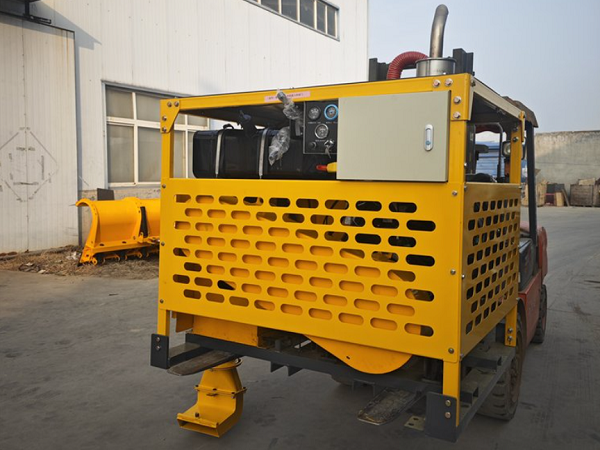
The highway snow blower belongs to the vehicle mounted road blower, and its core function is to blow the snow and debris on the road away from the lane through high-speed airflow. The equipment consists of three parts: power unit, air duct system, and walking mechanism. The power unit adopts an MH-20 engine with a rated power of 20kW and a rated speed of 3600RPM to provide stable driving force for the fan. The key component of the air duct system is the roller shaft, with a diameter of 60mm and a specification of 400mm, which is responsible for converting the mechanical energy of the engine into high-speed airflow. In terms of walking mechanism, the equipment has the ability to spread at a speed of 2m/min and travel at a speed of 10m/s, balancing operational efficiency and transition speed. It is worth noting that the device also integrates a cold storage bin with a capacity of 8m ³, which is used to store cold repair materials. This allows it to take into account minor road repairs while performing snow blowing operations, reflecting a multifunctional design concept. The parameters of milling width of 5000mm and milling depth of 60mm indicate that the equipment can also perform road milling operations when necessary, further expanding its application range.
II. How do technological differences affect practical applications
The actual effect of a snow blower depends not only on the engine power, but also on the matching efficiency between the air duct design and the engine. The setting of a rated power of 20kW and a rated speed of 3600RPM means that the engine continues to output power at high speeds, which is suitable for continuous, high load snow blowing operations. The combination of a roller diameter of 60mm and a specification of 400mm determines the flow velocity and flow rate of the airflow: the larger the diameter, the more air can be driven per unit time, but it also puts higher demands on the torque output of the engine. If the engine is not properly matched with the air duct, there may be problems such as a decrease in engine speed and airflow attenuation. In addition, the difference between the driving speed of 10m/s and the paving speed of 2m/min reflects the different requirements of the equipment in operation mode and transition mode: low-speed stability is required during operation to fully remove snow, while high-speed is required during transition to improve efficiency. The presence of cold storage bins increases the weight and complexity of the equipment, but in return, it provides the ability for rapid on-site repairs. For highway maintenance, this means reducing the cost of secondary equipment deployment.
III. Application Scenarios and Understanding Framework
In highway cleaning scenarios, the selection of snow blowers should focus on the following dimensions: firstly, the matching relationship between engine power and air duct parameters, which determines the actual snow blowing efficiency; Secondly, the speed range of the walking mechanism can be flexibly switched between low-speed operation and high-speed transition; The third is whether the additional functions (such as cold storage bin and milling ability) match the daily maintenance needs, avoiding functional redundancy or insufficiency. For scenarios where snow blowing is the main focus and occasional repairs are required, a cold storage bin is a practical configuration; For pure snow blowing operations, priority should be given to air duct efficiency and engine stability. Understanding these design logics can help maintenance units make more reasonable equipment configuration judgments based on the snow accumulation, operation frequency, and maintenance needs of their own road sections.


