
Views: 1 Author: Site Editor Publish Time: 2026-09-28 Origin: Site


As one of the world's important food crops, potato cultivation efficiency directly affects agricultural output. Traditional manual sowing has problems of low efficiency and uneven row spacing, while mechanized sowing equipment can significantly improve planting quality and speed through standardized operation. As a specialized agricultural machinery, potato digger have achieved a leap from manual to automation by integrating functions such as trenching, sowing, fertilization and soil covering, becoming a key tool for modern agricultural large-scale planting.
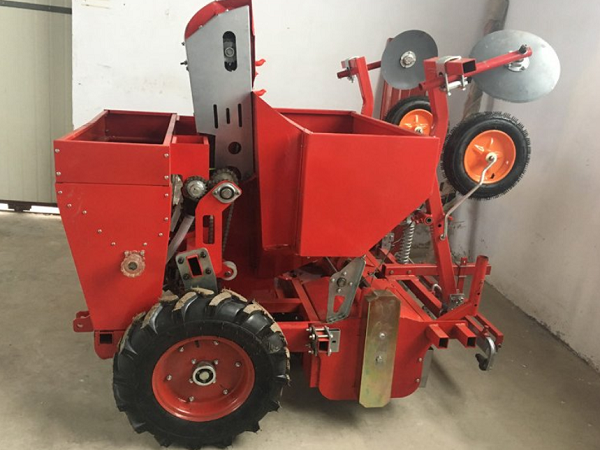
I. Core structure and working principle
The potato digger mainly consists of a frame, a trencher, a seed box, a fertilizer box, a seed planter, a soil cover wheel and a transmission system. When working, the tractor pulls the equipment forward through a three-point suspension device, and the trencher cuts a trench with a depth of 10-15 centimeters in the soil; The seed planter accurately pours the seed potatoes into the ditch according to preset parameters such as adjustable row spacing of 50-55 centimeters; At the same time, the fertilizer box synchronously applies fertilizer to the seed potatoes through the fertilizer guide tube; Finally, the covering wheel backfills and compacts the soil, completing the entire seeding process. The highlight of its design lies in achieving "simultaneous sowing of seeds and fertilizers" through mechanical linkage, reducing manual intervention and improving operational efficiency.
II. Key technical parameters and adaptability
The device model is 2CM-1 potato digger, with a total weight of 160kg, suitable for four-wheel tractors with 25-55 horsepower, and can meet the needs of small and medium-sized agricultural operations. The number of sowing rows is designed as single row and double row, with adjustable row spacing of 50-55 centimeters and flexible setting of ridge height of 12-30 centimeters, suitable for different terrains and planting modes. The adjustment range for sowing depth is 10-15 centimeters, which can match the soil depth requirements for potato tuber enlargement. The three-point suspension method ensures stable connection between the equipment and the tractor, reducing shaking errors during operation. In addition, the equipment supports customized processing and can adjust specifications and parameters according to user needs, further expanding its applicable scenarios.
III. Operating standards and maintenance points
Before use, it is necessary to check whether the seed planter, trencher and other components are loose, to ensure that there is no blockage between the seed potatoes and fertilizers; Keep the tractor running at a constant speed during operation (recommended speed of 3-5 kilometers per hour) to avoid missing or insufficient seeding depth caused by excessive speed; After sowing is completed, it is necessary to clean the seed box and fertilizer box residues to prevent corrosion of components. The equipment comes with a one-year warranty, and daily maintenance focuses include regular lubrication of the transmission chain, inspection of the wear of the covering wheel, replacement of aging trencher blades, etc. It is worth noting that this device is specifically designed for potatoes. If it is used for other crops, the parameters of the seeder need to be readjusted, otherwise it may affect the germination rate.
IIIV. Technical differences compared to similar products
Compared to traditional seeders, this equipment reduces the need for secondary fertilization and lowers labor costs by approximately 40% through the "seed fertilizer co sowing" technology; Its single row and double row design ensures ventilation and transparency while increasing planting density per unit area; Compared to fixed connections, three-point suspension structures are more suitable for complex terrain operations. In addition, the equipment adopts a lightweight design (160kg), which requires low tractor power and can be driven by 25 horsepower, reducing the usage threshold for small and medium-sized farmers. These technological improvements have resulted in a comprehensive advantage in efficiency, adaptability, and economy.


