
Views: 30 Author: Site Editor Publish Time: 2026-06-16 Origin: Site


Inside the automated workshop of Weichai Lovol's smart tractor manufacturing base in eastern China's Shandong Province, robotic arms weld tractor chassis with millimeter-level precision, while cloud systems synchronize production parameters for overseas customized orders. Every working day, more than 120 finished tractors roll off the assembly line, with over 60% destined for export markets across Central Asia, Southeast Asia and Latin America. Backed by technological upgrading, cost competitiveness and localized supply chains, Chinese farm tractors have recorded double-digit export growth in the first four months of 2026, reshaping the competitive landscape of the global agricultural machinery sector.
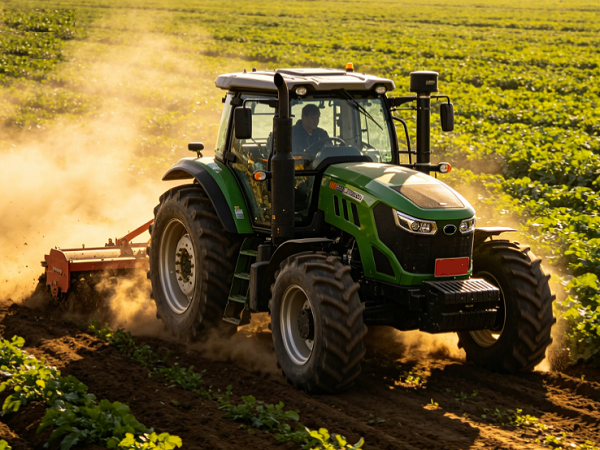
I. Surging Export Figures
Official customs data released in late May illustrates the explosive growth momentum. Between January and April 2026, China exported 65,440 farm tractors, a year-on-year increase of 19%, with total export turnover hitting 3.42 billion RMB, up 19.1% from the same period last year. The monthly export volume in April alone reached 16,953 units, marking the fifth consecutive month of positive growth. Breaking down regional sales, Belt and Road Initiative partner countries account for 62% of total tractor exports, while markets in Brazil, Argentina and other South American agricultural nations see a 27% year-on-year shipment surge.
II. Shift from Low-end to Tech-driven Production
For decades, global high-horsepower tractor markets were dominated by European and American brands including John Deere and New Holland, which occupied over 70% of global market share before 2020. Chinese manufacturers once focused solely on low-power, low-price small tractors for small-scale Asian farms. However, a five-year technological overhaul has erased this stereotype. Leading domestic manufacturers such as YTO Group, China's earliest tractor maker, and Weichai Lovol have invested over 8 billion RMB collectively in agricultural machinery R&D since 2022, focusing on intelligent navigation, dust-resistant hydraulic systems and low-emission power modules.
III. Customized Designs for Harsh Overseas Terrains
To adapt to harsh overseas farming environments, Chinese firms conduct targeted product iterations instead of exporting standardized domestic models. For arid, high-dust farmlands in Kazakhstan and Uzbekistan, engineers reinforce air filter sealing and upgrade engine cooling systems to prevent overheating under 40-degree Celsius extreme temperatures. All mid-to-high-end exported tractors are equipped with dual Beidou and GPS autonomous navigation modules, enabling automatic plowing, seeding and fertilizing with positioning errors below 5 centimeters. Local Kazakh farmer Askhat Nurlybek, who purchased a 220hp YTO tractor last spring, noted tangible operational improvements. "European tractors cost 35% more than Chinese equivalents, and their spare parts take one month to deliver. My Chinese tractor finished 120 hectares of plowing in two weeks, and local service stations provided on-site maintenance within 24 hours," he said in an interview.
IIIV. Localized Supply and After-sales Layout
Beyond product optimization, localized production and after-sales networks have become the core competitive edge for Chinese tractor brands. Traditional complete-machine export faces high cross-border logistics tariffs and long delivery cycles. To solve this pain point, YTO Group launched a "component export+overseas assembly" model in 2021, building a dedicated assembly plant in Kokshetau, northern Kazakhstan. The company ships disassembled tractor parts from Luoyang production bases via China-Europe freight trains, cutting logistics time by 10 days compared with sea shipping. The overseas facility now assembles more than 1,100 tractors annually, covering 90 to 280 horsepower models and has created 142 local technical jobs. Weichai Lovol has also established 29 spare parts warehouses and 17 authorized maintenance centers across Brazil and Southeast Asia in 2026, eliminating the after-sales anxiety that once deterred overseas buyers.
V. Core Drivers Behind Market Expansion
Industry analysts attribute the sector's breakout to three intertwined drivers. First, global food security pressures push developing economies to accelerate agricultural mechanization. The United Nations Food and Agriculture Organization reported that 48 low-income grain-producing countries face labor shortages and aging farming populations, creating massive demand for affordable mechanized equipment. Second, Chinese tractors maintain prominent cost-performance advantages: same-specification intelligent tractors are priced 25% to 40% lower than Western brands, with equivalent durability and intelligent functions. Third, policy support lowers cross-border trade barriers. China's export tax rebates for agricultural machinery and RCEP tariff exemptions have reduced comprehensive export costs by nearly 8% since 2025.
VI. Remaining Industrial Bottlenecks
Despite robust growth, the industry still faces structural challenges. High-end ultra-large horsepower tractors above 300 horsepower still rely partially on imported core transmission components, and brand recognition in Western European and North American consumer markets remains limited. In response, domestic manufacturers are accelerating core component localization. Weichai completed independent research and development of heavy-duty tractor transmissions in March 2026, breaking Western technological monopolies in this field. Meanwhile, enterprises are participating in mainstream global agricultural exhibitions, including the 2026 Brazil AgriTech Show, to launch region-specific green low-carbon tractors compliant with EU emission standards.
Looking ahead, industry forecasts project that China's annual tractor export volume will exceed 210,000 units by the end of 2026, with emerging markets in Africa and South Asia becoming the main growth engines. As global agricultural transformation deepens, Chinese farm tractor manufacturers are shifting from price-based competition to technology and service-driven growth. Rather than merely supplying farming equipment, they aim to provide one-stop digital farming solutions, integrating machinery maintenance, technical training and farm data management for global agricultural partners.


